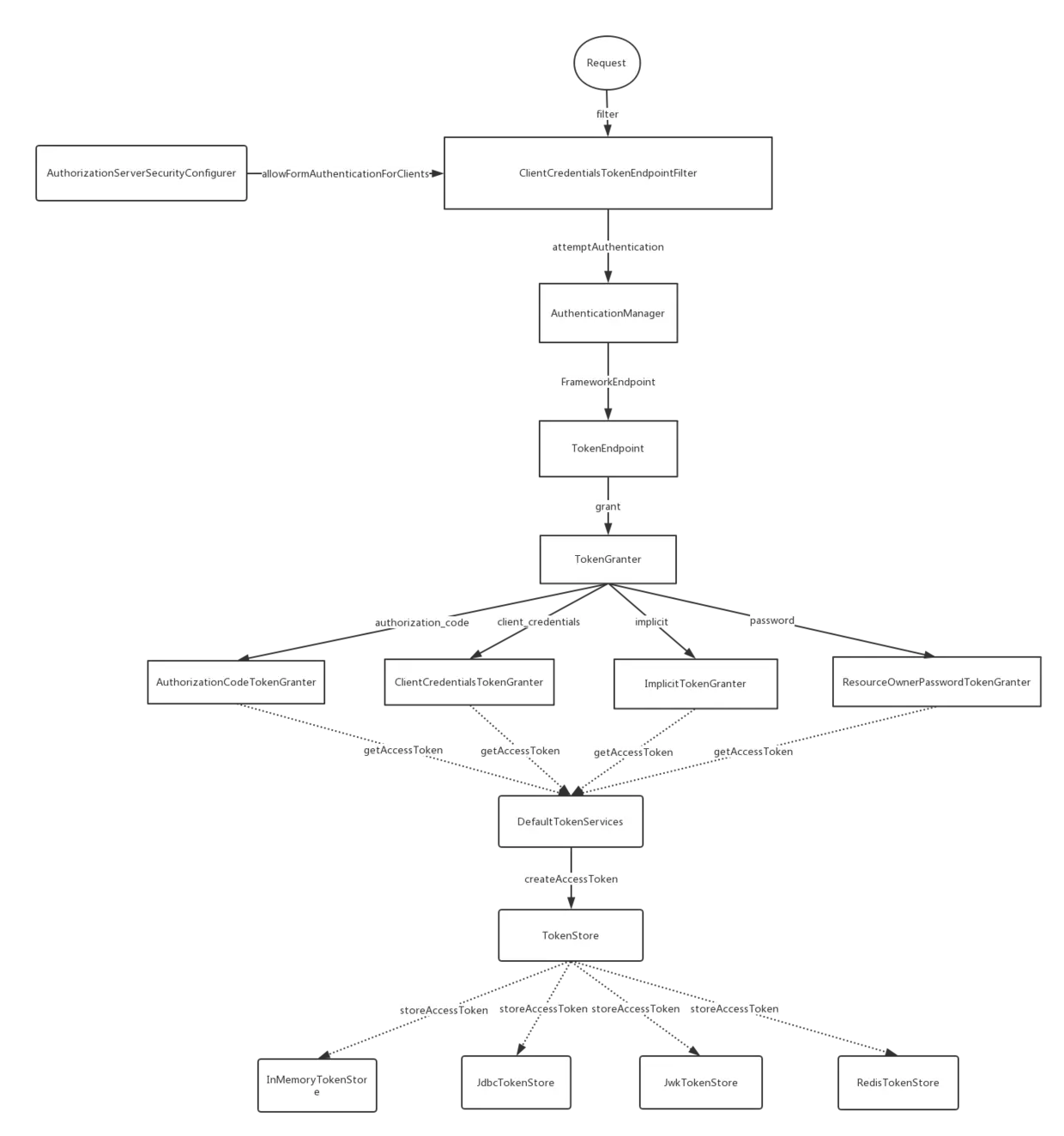
oauth2源码解读
请求token源码解读
进入AbstractAuthenticationProcessingFilter的doFilter方法
调用实现类ClientCredentialsTokenEndpointFilter的attemptAuthentication方法进行验证
通过clientId和clientSecret构建未认证的UsernamePasswordAuthenticationToken对象,调用authenticate方法对其进行认证
//ClientCredentialsTokenEndpointFilter类的attemptAuthentication方法
@Override
public Authentication attemptAuthentication(HttpServletRequest request, HttpServletResponse response){
    String clientId = request.getParameter("client_id");
    String clientSecret = request.getParameter("client_secret");
    // If the request is already authenticated we can assume that this
    // filter is not needed
    Authentication authentication = SecurityContextHolder.getContext().getAuthentication();
    if (authentication != null && authentication.isAuthenticated()) {
        return authentication;
    }
    UsernamePasswordAuthenticationToken authRequest = new UsernamePasswordAuthenticationToken(clientId,clientSecret);
    return this.getAuthenticationManager().authenticate(authRequest);
}
进入ProviderManager类的authentication方法中对AuthenticationProvider列表进行遍历,直到获得可以匹配传入的UsernamePasswordAuthenticationToken类的AuthenticationProvider类,即DaoAuthenticationProvider。
//ProviderManager类的authentication方法
public Authentication authenticate(Authentication authentication)
    throws AuthenticationException {
    Class<? extends Authentication> toTest = authentication.getClass();
    for (AuthenticationProvider provider : getProviders()) {
        if (!provider.supports(toTest)) {
            continue;
        }
        try {
            result = provider.authenticate(authentication);
            if (result != null) {
                copyDetails(authentication, result);
                break;
            }
        }
    }
    if (result != null) {
        return result;
    }
}
进入AbstractUserDetailsAuthenticationProvider的authenticate方法
public Authentication authenticate(Authentication authentication){
    // Determine username
    String username = (authentication.getPrincipal() == null) ? "NONE_PROVIDED": authentication.getName();
    UserDetails user = this.userCache.getUserFromCache(username);
    if (user == null) {
        try {
            user = retrieveUser(username,(UsernamePasswordAuthenticationToken)authentication);
        }
    }
    return createSuccessAuthentication(principalToReturn, authentication, user);
}
进入DaoAuthenticationProvider的retrieveUser方法调用loadUserByUsername方法
@Override
protected final UserDetails retrieveUser(String username, UsernamePasswordAuthenticationToken authentication){
    try {
        UserDetails loadedUser = this.getUserDetailsService().loadUserByUsername(username);
        return loadedUser;
    }
}
返回AbstractUserDetailsAuthenticationProvider的authenticate方法
调用 createSuccessAuthentication() 返回认证信息
//AbstractUserDetailsAuthenticationProvider的createSuccessAuthentication方法
protected Authentication createSuccessAuthentication(Object principal,
Authentication authentication, UserDetails user) {
    //在该方法中创建已认证的UsernamePasswordAuthenticationToken(将authenticated属性设置为true),并设置UserDetails后返回
    UsernamePasswordAuthenticationToken result = new UsernamePasswordAuthenticationToken(principal, authentication.getCredentials(),authoritiesMapper.mapAuthorities(user.getAuthorities()));
    result.setDetails(authentication.getDetails());
    return result;
}
最后返回调用AbstractAuthenticationProcessingFilter的successfulAuthentication方法
在其父类的successfulAuthentication方法中将已认证的UsernamePasswordAuthenticationToken放置到安全上下文中
//ClientCredentialsTokenEndpointFilter的父类AbstractAuthenticationProcessingFilter的successfulAuthentication方法
protected void successfulAuthentication(HttpServletRequest request,
HttpServletResponse response, FilterChain chain, Authentication authResult) {
    SecurityContextHolder.getContext().setAuthentication(authResult);
    rememberMeServices.loginSuccess(request, response, authResult);
    // Fire event
    if (this.eventPublisher != null) {
        eventPublisher.publishEvent(new InteractiveAuthenticationSuccessEvent(
            authResult, this.getClass()));
    }
    successHandler.onAuthenticationSuccess(request, response, authResult);
}
最后调用下一级过滤器。因为已经设置到安全上下文中,所以过滤器放行,请求最终到达TokenEndpoint类的/oauth/token接口中
生成token源码解读
- 进入到了TokenEndpoint类的/oauth/token接口
@FrameworkEndpoint
public class TokenEndpoint extends AbstractEndpoint {
    @RequestMapping(value = "/oauth/token", method=RequestMethod.POST)
    public ResponseEntity<OAuth2AccessToken> postAccessToken(Principal principal, @RequestParam Map<String, String> parameters) {
        // 1. 从 principal 中获取 clientId, 进而 load client 信息
        String clientId = getClientId(principal);
        ClientDetails authenticatedClient = getClientDetailsService().loadClientByClientId(clientId);
        // 2. 从 parameters 中拿 clientId、scope、grantType 组装 TokenRequest
        TokenRequest tokenRequest = getOAuth2RequestFactory().createTokenRequest(parameters, authenticatedClient);
        // 3. 校验 client 信息
        if (clientId != null && !clientId.equals("")) {
            if (!clientId.equals(tokenRequest.getClientId())) {
                // 双重校验: 确保从 principal 拿到的 client 信息与根据 parameters 得到的 client 信息一致
                throw new InvalidClientException("Given client ID does not match authenticated client");
            }
        }
        if (authenticatedClient != null) {
            oAuth2RequestValidator.validateScope(tokenRequest, authenticatedClient);
        }
        // 4. 根据 grantType 设置 TokenRequest 的 scope。
        // 授权类型有: password 模式、authorization_code 模式、refresh_token 模式、client_credentials 模式、implicit 模式
        if (!StringUtils.hasText(tokenRequest.getGrantType())) {
            throw new InvalidRequestException("Missing grant type");
        }
        if (tokenRequest.getGrantType().equals("implicit")) {
            throw new InvalidGrantException("Implicit grant type not supported from token endpoint");
        }
        // 如果是授权码模式, 则清空从数据库查询到的 scope。 因为授权请求过程会确定 scope, 所以没必要传。
        if (isAuthCodeRequest(parameters)) {
            if (!tokenRequest.getScope().isEmpty()) {
                logger.debug("Clearing scope of incoming token request");
                tokenRequest.setScope(Collections.<String> emptySet());
            }
        }
        // 如果是刷新 Token 模式, 解析并设置 scope
        if (isRefreshTokenRequest(parameters)) {
            // A refresh token has its own default scopes, so we should ignore any added by the factory here.
            tokenRequest.setScope(OAuth2Utils.parseParameterList(parameters.get(OAuth2Utils.SCOPE)));
        }
        // 5. 通过令牌授予者获取 token
        OAuth2AccessToken token = getTokenGranter().grant(tokenRequest.getGrantType(), tokenRequest);
        if (token == null) {
            throw new UnsupportedGrantTypeException("Unsupported grant type: " + tokenRequest.getGrantType());
        }
        return getResponse(token);
    }
}
- 各授权模式对应的 TokenGranter
| 实现类 | 对应的授权模式 |
|---|---|
| AuthorizationCodeTokenGranter | 授权码模式 |
| ClientCredentialsTokenGranter | 客户端模式 |
| ImplicitTokenGranter | implicit 模式 |
| RefreshTokenGranter | 刷新 token 模式 |
| ResourceOwnerPasswordTokenGranter | 密码模式 |
通过getTokenGranter方法获取AuthorizationServerEndpointsConfigurer,以tokenRequest作为参数,调用grant方法获取token
在该方法中调用了CompositeTokenGranter类的grant方法,
CompositeTokenGranter的属性
List<TokenGranter>中包含了如下5种授权模式。
//CompositeTokenGranter类的grant方法
public OAuth2AccessToken grant(String grantType, TokenRequest tokenRequest) {
for (TokenGranter granter : tokenGranters) {
   OAuth2AccessToken grant = granter.grant(grantType, tokenRequest);
   if (grant!=null) {
       return grant;
   }
}
return null;
}
遍历
List<TokenGranter>寻找合适的TokenGranter,调用grant方法返回生成的OAuth2AccessToken。其子类继承了grant方法,判断每个子类的grantType属性是否和请求的grantType一致,最终匹配到ResourceOwnerPasswordTokenGranter。
//AbstractTokenGranter类的grant,getAccessToken和方法
public OAuth2AccessToken grant(String grantType, TokenRequest tokenRequest) {
    if (!this.grantType.equals(grantType)) {
        return null;
    }
    String clientId = tokenRequest.getClientId();
    ClientDetails client = clientDetailsService.loadClientByClientId(clientId);
    validateGrantType(grantType, client);
    if (logger.isDebugEnabled()) {
        logger.debug("Getting access token for: " + clientId);
    }
    return getAccessToken(client, tokenRequest);
}
protected OAuth2AccessToken getAccessToken(ClientDetails client, TokenRequest tokenRequest) {
    return tokenServices.createAccessToken(getOAuth2Authentication(client, tokenRequest));
}
createAccessToken方法的参数是OAuth2Authentication,通过getOAuth2Authentication方法获得,ResourceOwnerPasswordTokenGranter重写了父类的该方法
@Override
protected OAuth2Authentication getOAuth2Authentication(ClientDetails client, TokenRequest tokenRequest) {
 Map<String, String> parameters = new LinkedHashMap<String, String>(tokenRequest.getRequestParameters());
 String username = parameters.get("username");
 String password = parameters.get("password");
 // Protect from downstream leaks of password
 parameters.remove("password");
 Authentication userAuth = new UsernamePasswordAuthenticationToken(username, password);
 ((AbstractAuthenticationToken) userAuth).setDetails(parameters);
 try {
     userAuth = authenticationManager.authenticate(userAuth);
 }
 if (userAuth == null || !userAuth.isAuthenticated()) {
     throw new InvalidGrantException("Could not authenticate user: " + username);
 }
 OAuth2Request storedOAuth2Request = getRequestFactory().createOAuth2Request(client, tokenRequest);
 return new OAuth2Authentication(storedOAuth2Request, userAuth);
}
调用AuthorizationServerTokenServices的子类DefaultTokenServices的createAccessToken方法生成OAuth2AccessToken。
该方法使用了tokenStore.getAccessToken(authentication)来获取的token。如果getAccessToken返回的token是null,则直接创建新的token;如果getAccessToken返回了持久化的token,则判断token是否过期,如果未过期则根据OAuth2Authentication 信息重新存储token以防信息变更
在DefaultTokenServices的createAccessToken方法中创建DefaultOAuth2AccessToken 并将expiration、refreshToken、scopes等信息存储到其中,得到token
//DefaultTokenServices类
private OAuth2AccessToken createAccessToken(OAuth2Authentication authentication, OAuth2RefreshToken refreshToken) {
String tokenValue = new String(Base64.encodeBase64URLSafe(DEFAULT_TOKEN_GENERATOR.generateKey()),  US_ASCII);
DefaultOAuth2AccessToken token = new DefaultOAuth2AccessToken(tokenValue);
int validitySeconds = getAccessTokenValiditySeconds(authentication.getOAuth2Request());
if (validitySeconds > 0) {
   token.setExpiration(new Date(System.currentTimeMillis() + (validitySeconds * 1000L)));
}
token.setRefreshToken(refreshToken);
token.setScope(authentication.getOAuth2Request().getScope());
return accessTokenEnhancer != null ? accessTokenEnhancer.enhance(token, authentication) : token;
}
在最后会通过accessTokenEnhancer的enhance方法对该token进行强化
public class TokenEnhancerChain implements TokenEnhancer {
private List<TokenEnhancer> delegates = Collections.emptyList();
/**
    * @param delegates the delegates to set
    */
   public void setTokenEnhancers(List<TokenEnhancer> delegates) {
       this.delegates = delegates;
   }
   /**
    * Loop over the {@link #setTokenEnhancers(List) delegates} passing the result into the next member of the chain.
    */
   public OAuth2AccessToken enhance(OAuth2AccessToken accessToken, OAuth2Authentication authentication) {
       OAuth2AccessToken result = accessToken;
       for (TokenEnhancer enhancer : delegates) {
           result = enhancer.enhance(result, authentication);
       }
       return result;
   }
}
此处会遍历
List<TokenEnhancer>寻找合适的 TokenEnhancer ,并调用enhance方法对OAuth2AccessToken 进行加强。最后在TokenEndpoint类中调用getResponse方法将OAuth2AccessToken 设置到返回参数中
//TokenEndpoint类的getResponse方法
private ResponseEntity<OAuth2AccessToken> getResponse(OAuth2AccessToken accessToken) {
    HttpHeaders headers = new HttpHeaders();
    headers.set("Cache-Control", "no-store");
    headers.set("Pragma", "no-cache");
    headers.set("Content-Type", "application/json;charset=UTF-8");
    return new ResponseEntity<OAuth2AccessToken>(accessToken, headers, HttpStatus.OK);
}